

Foxes, Hedgehogs, and Grass Snakes: The Real Reason 90% of New Businesses Fail
Exploring the strategic dichotomy between knowledge acquisition and business execution through Isaiah Berlin's fox-hedgehog concept and its application to modern business strategy

There’s an ancient Greek parable. The fox knows many things. The hedgehog knows one thing – something very important.
The fox is a cunning creature, capable of inventing a million complicated strategies to attack the hedgehog. Day after day, the fox circles around the hedgehog’s burrow, waiting for the right moment to pounce. Fast, agile, beautiful, and sly, the fox seems destined to win. The hedgehog is clumsy and looks like a mix between a porcupine and an armadillo. All day long he runs around the forest looking for something to eat.
The fox waits, hiding silently at a crossroads of forest paths. The hedgehog walks by, suspecting nothing, straight into the fox’s paws. “Aha” thinks the fox, “got you now”! She leaps out and rushes toward the hedgehog. The little hedgehog, sensing danger, looks up and thinks: “Here we go again… will she never learn anything”? – and curls up into a neat little ball. The hedgehog becomes a sphere with sharp needles sticking out in all directions. The fox, leaning over her prey, sees the defense and abandons the attack.
Every day this battle repeats. Despite the fox’s superior cunning, the hedgehog always wins.
The philosopher Isaiah Berlin made this parable famous in his essay “The Hedgehog and the Fox,” dividing humanity into these two types. Foxes see the world in all its complexity and try to pursue several goals at once. As a result, they rarely achieve success. Hedgehogs reduce the diversity of the world to a simple but effective concept and follow it meticulously, without being distracted by anything else.
Years later, Jim Collins (the business researcher behind “Good to Great”) built on this philosophy to derive the “Hedgehog Concept” for business. In his view, truly great companies became great only because they followed a reliable and simple strategy – one “so clear that even a hedgehog could understand it.”
Simple, right? Hedgehogs good, foxes bad. Focus beats complexity.
Except when it doesn’t: learning requires fox thinking. Building requires hedgehog thinking. They are opposite strategies for opposite activities, and today’s talk is how to master them both.

Learning Requires Fox Thinking
For me, learning is very similar to geological exploration.
Imagine a new continent. You know nothing about it. Yes, you see mountains, forests, rivers, but you have very little idea what’s inside. You don’t know what lies beyond the horizon, whether there are seas, how cold it is in the north, or what the temperature is in the south.
You start by making a map. You send expeditions in all directions and draw a map of the terrain. Then you start drilling exploratory wells and finding out the composition of the ground. Then you discover oil, gold, diamonds and begin extraction.
Learning follows exactly this scenario.

You’re studying programming. It would be quite foolish to immediately throw yourself into deep theory of artificial intelligence or lambda calculus. It’s just as foolish to dive deep into one specific language right away. First, you need to learn the history of the field, how everything developed, what directions exist, what they are for and what they deal with. What paradigms, types of languages, platforms, connections between them, development prospects exist. If you try to build a map of the “software development” continent, it will be much easier for you to understand where to start.
At first, you need to be a fox, and then turn into a hedgehog.
Sometimes some areas connect for you almost into a single whole, and instead of a bridge, an archipelago rises. In this moment, you establish connections between disciplines. Gradually, the connection becomes obvious and stable, the archipelago turns into land, and you build a high-speed highway across it.
Fo example: why is differential calculus taught separately in school programs? Why is it never and nowhere mentioned how it is applied in practice? Modern education helps you discover and master new islands, but practically does not help you discover and master continents. Very little attention is paid to connections. And this is bad.
Then comes the critical moment. The point is chosen and the drill is sharpened. How should you drill?
In one book I read a good analogy. At first, you are in a dark room and you explore objects by touch. And at some point, the light turns on and it becomes absolutely clear where everything stands. The same thing happens in your head. Suddenly the light comes on and all the scattered concepts line up into a clear picture. This moment is impossible to forget, and this clear picture will never be erased. The light will stay on all the time.

Sometimes it is very hard to continue drilling. When you see that nothing is changing, that you’ve been hammering away at a topic for several months without significant progress, you want to drop everything to hell and go somewhere warm. What should you do in this case? There is only one answer – continue. If you quit once, then quit again, you will simply lose confidence in your abilities. You will think that you are incapable of anything and get stuck at your current level forever.
What distinguishes great programmers from average ones? Possibly only the fact that great programmers always believed they could become great, and average ones never believed it and stopped drilling. Faith in your own abilities can work miracles.
The problem is that in the modern world it’s much easier to remain a fox forever than to become a hedgehog. I feel for myself that it’s become much harder to work deeply on a chosen field. There’s always a desire to read just one more blog post, check twitter, get distracted by an interesting youtube video. In a world where information is at your fingertips, the temptations to be a fox are enormous.
But for learning, this fox-then-hedgehog progression works. We’re trained in this. It works beautifully.
So we apply it everywhere. Including business.
That’s where everything falls apart.
Business Requires Hedgehog Execution
The “Hedgehog Concept” strategy is not a goal to become the best, not a strategy to become the best, not an intention to become the best, not a plan for how to become the best. It is an understanding of what you can be the best at. And this distinction is extremely important.
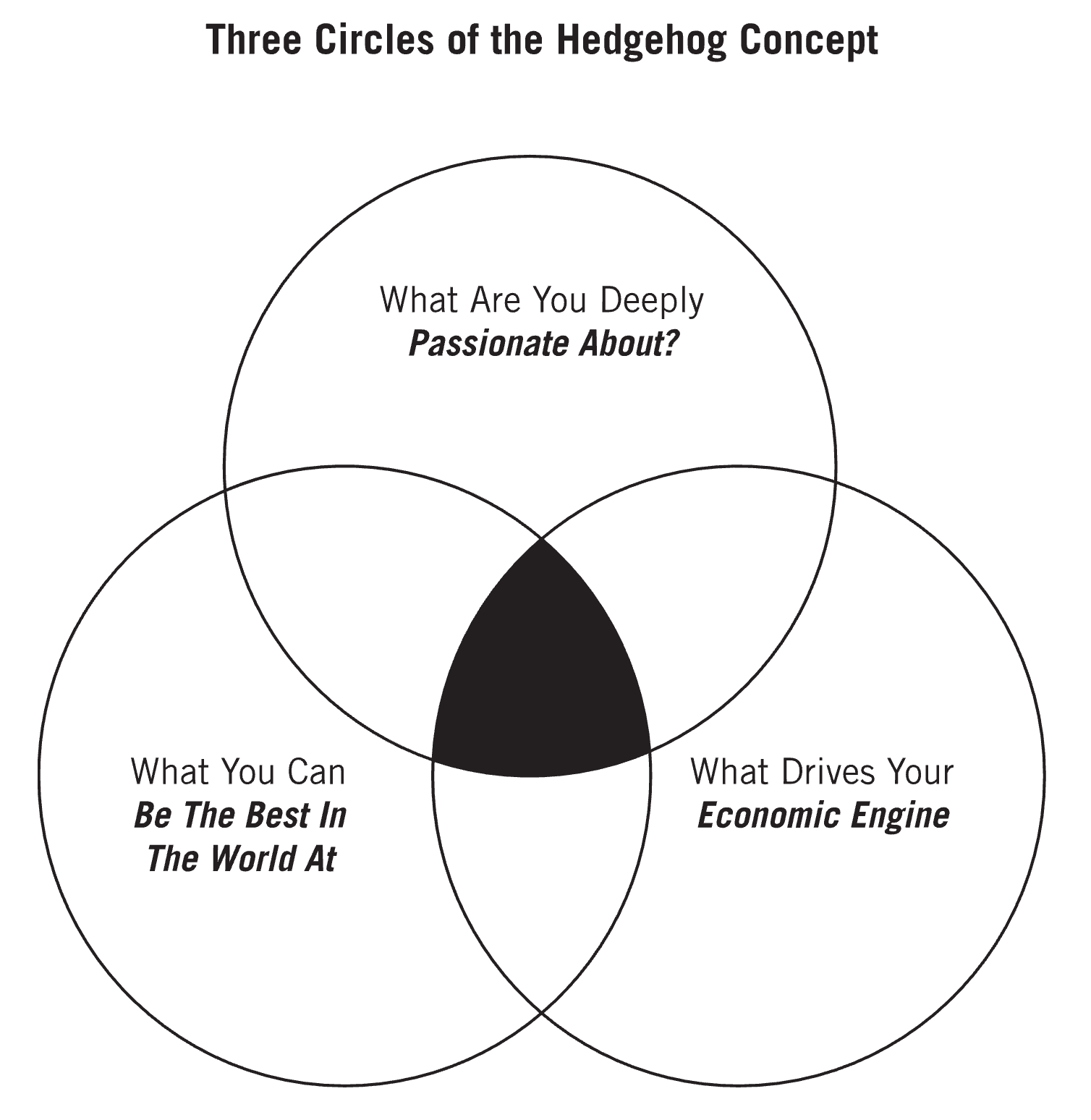
Usually the “hedgehog concept” is depicted as three intersecting circles. Each one contains a range of answers to one of three questions:
What are you deeply passionate about?
What can you do better than anyone else in the world?
What is your economic engine based on?
If these three circles intersect to form a triangle-like shape, woop! – a brilliant idea for the best business in the world has been found. All that remains is to bring it to life.
But here’s what founders miss. You don’t need to map these circles. You need to pick one intersection and drill immediately.
My purely personal impression (which may well be wrong) is that people with technical backgrounds tend to follow the “fox” path in business. The reverence for broad erudition instilled at their alma mater pushes them to act in multiple directions at once. They try to build a “super”-wide product line. At the same time, they deal with technology, innovation, sales, advertising, PR, team building, customer loyalty, product expansion, and God knows what else. At the same time, “foxes” try not to miss any opportunity to enter new fields.

People with humanities backgrounds, it seems, usually choose the “hedgehog” strategy. They focus on one thing, simple and personally understandable. For instance: first a small pharmacy kiosk, then a full pharmacy, then several, then an entire pharmacy chain with carefully planned locations. “Hedgehogs” don’t stray from their chosen strategy, even if you promise them a 500% profit in a completely new line of business (say, issuing “fast loans” to anyone who wants one at pharmacy counters).
Probably, it’s impossible to say unambiguously which of the two styles is the “right” one. Both “foxes” and “hedgehogs” can build a successful business (and both can fail completely). There is only one nuance:
“Hedgehogs” fail more often at the very beginning, when fast reaction and flexible tactics are critically important. This way the price of strategic mistakes is extremely high.
“Foxes,” on the other hand, are undermined by weak management, where they forced to operate in a dozen very different, sometimes qualitatively different, areas at once.
The Grass Snake Trap
And finally: once again about the “grass snakes.” Everything about them is already clear. Those born to crawl cannot fly. A creeping thing is doomed to creep. And so on and so forth.
But sooner or later, some of these “grass snakes” start thinking about moving into another category. Business class. In other words, they start thinking about building their own business. And immediately they face a dilemma: what to become. Which animal to put on their banner: a fox or a hedgehog?
Some of them try to enter the business league via the fox’s path. That is, they first accumulate knowledge in a wide range of fields “necessary” for starting their own business. They take dozens of courses, read hundreds of books, study various forums, websites, and blogs. They prepare thoroughly and seriously.

Other “grass snakes” refine their business idea and gradually start implementing it – through freelancing, part-time work, volunteering, and so on. In other words, they step onto the hedgehog’s path, concentrating on one single thing. This seems to be the more workable approach.
Here’s some initial diagnostic. If you’ve been “preparing to launch” for more than three months, you’re stuck in fox thinking. You’re mapping. If your business is in year two and you’re still “exploring opportunities,” same problem. You never started drilling.
When to Keep Drilling, When to Move
But another question arises if you don’t particularly like drilling at your chosen point. Most likely, you need to do something else. If studying a topic brings no satisfaction at all and when opening a new book you immediately check how many pages it has – the topic is not for you. Walk across your map and find another place. Maybe you’re interested in UX, or automation, or marketing. A couple of trial wells, and you will understand where you can try to apply your efforts.

The critical difference: in learning, you drill until the light comes on. That’s internal validation. In business, you drill until revenue comes in. External validation. The timeline is different. In business, meaningful revenue might take twelve months of focused execution.
The pharmacy chain is worth more than the conglomerate with seven business lines. Why? Defensible expertise. Repeatable systems. Clear positioning. Manageable at scale.
The conglomerate has none of these. It’s still mapping.
Every day the battle between the fox and the hedgehog is repeated, and despite the fox’s superior cunning, the hedgehog always wins.
So which should you be?
Here’s the answer: both, but never at the same time.
In learning, be the fox first, then the hedgehog. Map broadly to understand the territory. Then drill deep where you find gold. This is how you master anything worth mastering.
In business, be the hedgehog from day one. You don’t get to explore first. The market won’t wait while you “figure things out”. Pick your intersection (passion, capability, economics) and drill. That’s it.
Choose who you are! Until then, see you in a next episode of TechTrendsetters.
🔎 Explore more: